Quests, not feeds
An assistant that works for you should offer a few finite tasks with stated reasons and then stop, instead of an endless feed ranked to keep you scrolling. As AI makes content almost free to produce, deciding what deserves your attention becomes the assistant's main job.
Feeds have no end, and they are ranked by companies paid for your attention, on a schedule of unpredictable rewards that keeps you swiping. Generative AI makes the flood much larger: text and images now cost almost nothing to produce, in any volume, tuned to whoever is watching.
The useful question becomes: what, out of all this, actually needs you today? A quest answers it with a clear task, a reason, and a finish line.
Why feeds leave us tired
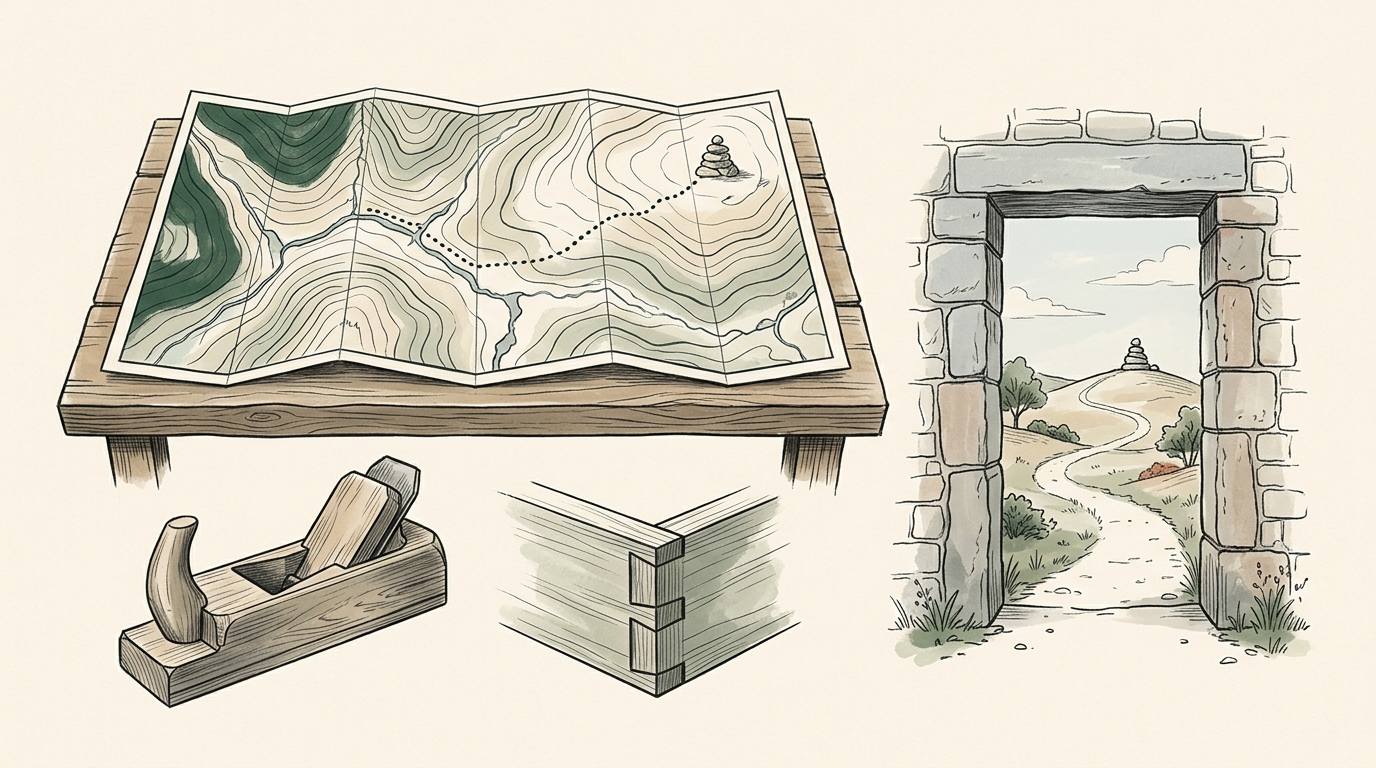
When you sit down with a hiking trail map or a woodworking project plan on your workbench, the document has an honest shape. A woodworking plan lists the boards you need to cut, the mortise and tenon joints you need to fit, and the final coat of oil. A trail map shows the trailhead in the valley, the switchbacks through the pines, and the stone cairn on the ridge.
Most importantly, both have a finish line. When the shelf is clamped and drying on the bench, or when you reach the summit cairn and eat your sandwich, the plan has done its job. You fold the map, put the hand plane back in its rack, and go outside.
An infinite feed is built for the opposite purpose. Because it sells your attention to advertisers, ending is treated as a business failure. Workplace studies show that constant digital interruptions force people to work faster just to make up lost time, and that extra speed comes with significantly higher stress, frustration, and mental strain.1
Meanwhile, the real responsibilities that genuinely need your care get buried in the rubble. A clinic permit with a Friday deadline sits beneath forty promotional emails. A thoughtful note from your sister disappears under automated group alerts. A clogged heat-pump filter that takes five minutes to rinse today turns into an expensive repair next winter. They are easy to miss not because they are hidden, but because they are surrounded.
What this means
A filter ranked by what keeps you scrolling works for the casino, not for you. An assistant that works only for you should show the few things that matter, explain why, and then stop.
A trail map for your day
Well-crafted adventure games and field guides use a simple device. Instead of an endless stream of chatter, you see a small journal listing a handful of active quests. Each quest has a clear reason why you took it on and a concrete next step. Nothing scrolls forever, and the journal stays closed when you are walking through the woods.
We think a personal software interface should work the same way. In the design we propose, an assistant running on your own device answers only to you. With your permission, it checks your calendar, your messages, and the household notes you keep, and from that noisy flood, surfaces two or three finite quests for the morning.
Decades of psychology research show that people thrive when daily tasks serve goals they actually chose for themselves and let them see real competence and progress.2 Cognitive scientists have also shown for decades that human working memory can hold only a few distinct items at once before comprehension and judgment degrade.3 Clearing away the clutter leaves mental room for real thought, craft, and the people in front of you.
What a quest looks like in practice
Picture opening your screen at eight-thirty with a cup of coffee. Instead of forty unread badges and an algorithmic stream of strangers arguing about the news, you see a calm card with three items:
- Sign and return the community clinic permit. Your assistant shows the exact clause that changed since last year and notes that the filing window closes on Friday.
- Reply to your sister's note about train tickets. It surfaced this message above thirty automated newsletters because you set a rule never to bury family messages.
- Rinse the downstairs heat-pump filter. Your monthly house log shows it has been thirty-two days since the last check, and a ten-minute rinse keeps the compressor healthy.
You review the permit, send a two-sentence reply to your sister, and walk downstairs to rinse the screen. At nine-fifteen, you mark the third box complete. Instead of sliding three more items onto the pile, the window congratulates you, tells you the list is clear, and closes itself so you can start your real work or step outside.
Compare how your body feels at nine-fifteen in those two worlds. After forty-five minutes on a slot-machine feed, your eyes are dry, your shoulders are tense, and your morning errands are still untouched. After finishing three bounded quests, the small weights at the back of your mind are gone. You have your whole morning back.
That same boundary helps when you sit down with a weekend project. Whether you are planing a bookshelf board in the garage or planting tomatoes in the garden, your assistant holds non-urgent messages until Monday morning. Instead of buzzing every six minutes with a new headline, it guards your free hours until you ask what is next.
Six rules that keep a quest from becoming a feed
Any ranked list can drift back toward a slot machine if you are not careful. Our proposed design rests on six strict commitments, each meant to close off a specific way that today's feeds go wrong.
- Strictly opt-in and revocable. The window is off until you turn it on. You choose which folders or messages your assistant may read, and you can disconnect any source at any time.
- Visible, checkable reasons. Every quest states its clear reason: a permit expires Friday, or family messages need attention. Matches come from verifiable rules, not a model guessing in the dark.
- A few items, then stop. The window shows a short list and stops. Finishing it is the whole goal. There is no infinite scroll and no "one more thing" waiting at the bottom.
- No engagement tricks. No streaks, no login badges, no flame icons, and no notifications designed to pull you back in. The tool succeeds when you need it less, not when you stare at it longer.
- A suggestion, never an order. A quest can point out a form you need to sign or a message worth answering. It never acts without your say-so, and it never tells you what to believe.
- Feelings never leave your device. You can tell your assistant that a reminder was a relief or that a topic left you anxious. That feedback stays on your machine, never sent to a remote server, sold, or pooled.
How this could fail
This interface is still a design proposal rather than finished software, and we want to be candid about how it could go wrong. If a quest window only ever shows what feels comfortable, it could become a filter bubble that helps you avoid hard truths. A good assistant must still surface unwelcome deadlines and bills, while letting you inspect or reset what it has learned.
There is also a subtle trap in how people choose tasks. When we are tired, we often gravitate toward tiny errands that feel good to check off while avoiding the one difficult project that actually matters. A thoughtful quest window has to protect deep, unhurried work rather than turning your day into a game of trivial checkboxes.
Finally, there is the risk of outside manipulation. As AI agents grow more capable, commercial senders will try to disguise spam or persuasion as urgent quests for your assistant. Reasons must be verifiable, and sources that try to game your window should lose its trust immediately.
Above all, if advertisers, platforms, or institutions can buy or force placement in the window, it stops working for you. And if people who try it do not feel less overwhelmed in their actual lives, then it is not worth building.
The finish line
Think of the last time you finished a real project with your hands. Maybe it was a pine shelf planed smooth in your workshop, a meal cooked for friends, or a hike to a windy ridge. The best part was the moment you knew you were done.
Good tools should respect human time by having an ending. Like a trail map or a woodworking plan, they should help you spot what matters, finish it well, and then close themselves so you can step back into your day.
1. Gloria Mark, Daniela Gudith and Ulrich Klocke, "The Cost of Interrupted Work: More Speed and Stress", Proceedings of the SIGCHI Conference on Human Factors in Computing Systems (CHI '08), pp. 107–110 (2008). doi.org/10.1145/1357054.1357072
2. Richard M. Ryan and Edward L. Deci, "Self-Determination Theory and the Facilitation of Intrinsic Motivation, Social Development, and Well-Being", American Psychologist, 55(1), 68–78 (2000). doi.org/10.1037/0003-066X.55.1.68
3. John Sweller, "Cognitive Load During Problem Solving: Effects on Learning", Cognitive Science, 12(2), 257–285 (1988). doi.org/10.1207/s15516709cog1202_4