Why the internet needs a second road
Cities learned long ago to keep freight trains off the footpaths. Both need to move. Neither should get in the other's way. The internet is about to learn the same lesson.
Here is a fact that would have sounded like science fiction a decade ago. In 2024, for the first time in ten years, automated traffic made up more of the web than human traffic did, an estimated 51 percent.1 Some of those bots are helpful, like the crawlers that let search engines index a library catalogue. Many aren't.
Now add AI agents to that crowded street. Unlike older bots that followed rigid scripts, modern agents can read a page, click buttons, fill in forms, and reply in warm, plausible sentences just like you would. Sometimes they say they're software. Often they don't.
You've probably felt the result already in daily frustrations. Product reviews you can't trust because hundreds were written in an afternoon by a synthetic swarm. Replies that sound almost human until you notice the same phrase repeated twenty times down the page. Customer service lines where one chatbot argues endlessly with another.
None of this happened because the original internet was poorly designed. It happened because we are asking one narrow road to carry two completely different kinds of traffic at once.
A medieval market street with forty-ton trucks
The early internet was built as a single shared road. People, simple scripts, and now AI agents all travel down that same lane together, wearing the same digital clothes, and they are hard to tell apart. That worked when software only did simple chores in the background. It breaks down when software can write, persuade, and act faster than any person can follow.
Picture a medieval market street in an old stone town. The lane was laid out centuries ago for neighbours walking on foot, parents pushing handcarts, and stallholders setting out baskets of bread and apples. People move at walking speed. They stop to talk, look a baker in the eye, and judge whether the fruit looks fresh.
Now imagine routing forty-ton freight trucks, automated forklifts, and high-speed delivery vans straight down that same narrow cobblestone lane. Many of those trucks are carrying real timber, grain, and medicine that the town genuinely needs. Yet because heavy freight and pedestrians are squeezed into the same passage, the market becomes unlivable. Walkers are pressed flat against shopfronts, and conversations are drowned out by diesel engines.
The usual fix on today's web is to bolt stricter turnstiles onto every shop door. Websites add aggressive filters and endless CAPTCHAs, asking you to click blurry bicycles and traffic lights to prove you're human. That helps for a moment. Mostly, it makes the footpath exhausting for real people, especially anyone using a screen reader or a shared library connection. Meanwhile, commercial bots keep getting better at passing the test in milliseconds.
A second road: the freight canal and the lock-keeper
We think there's a better approach than turning the whole web into a checkpoint: give software agents a network of their own.
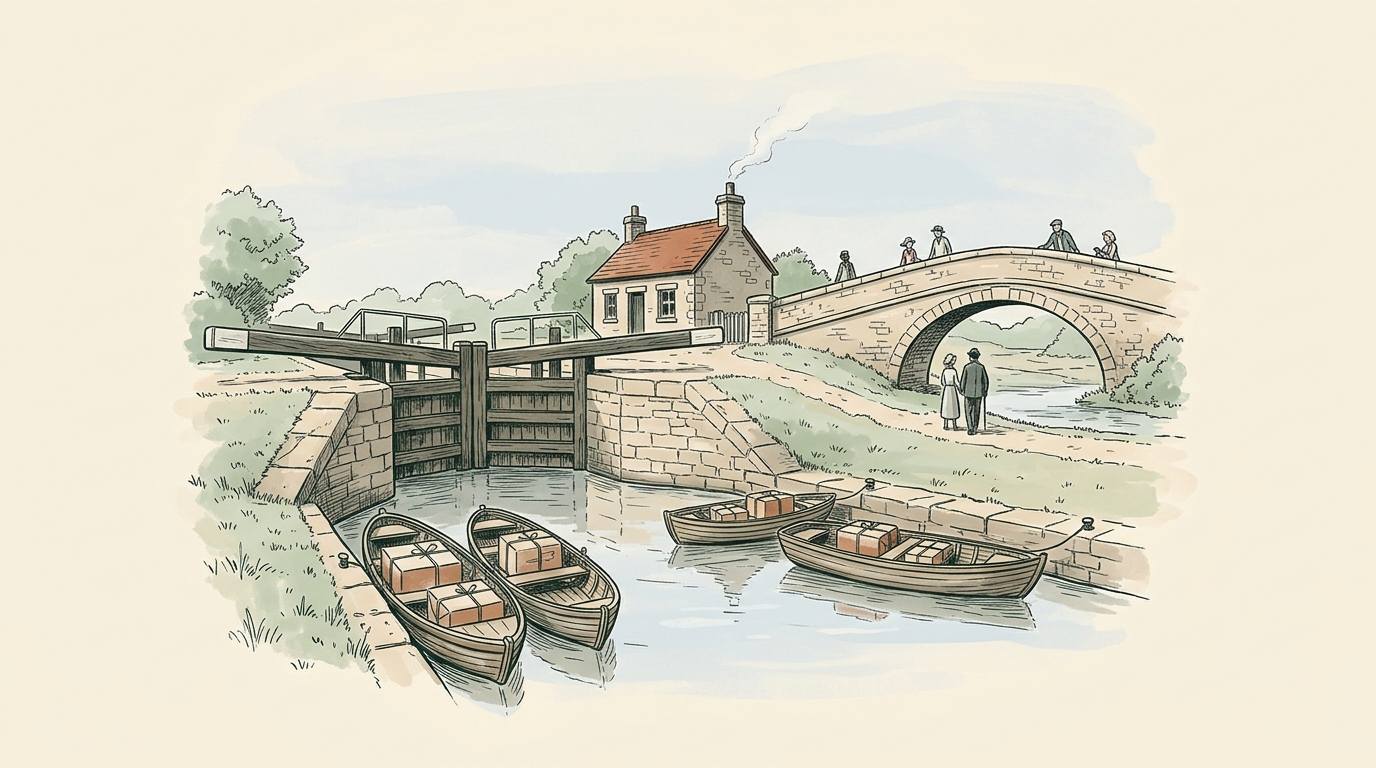
Picture how trading towns solved their traffic crisis when heavy cargo outgrew the cobblestone streets. They dug a dedicated freight canal running beside the town, separated from the pedestrian lanes by stone walls. Barges move timber, coal, and parcels along the water quickly and in bulk. Above the water, people stroll, browse market stalls, and talk at a human pace on the footpaths.
The canal and the footpath never blur into one another. They meet only at specific basins, like a canal lock with a lock-keeper and a harbour pilot. Every vessel has to slow down at the lock, show its papers, and state its business before anything crosses onto the quay.
On the agent freight canal, three simple rules apply to every vessel on the water:
- Every barge carries a hull number and a registered owner. Every software agent is tied to an accountable person or organisation that stands behind its actions.
- Every parcel travels with a customs manifest and a receipt. Each message states what the agent is allowed to do, and leaves a signed receipt you can check.
- Harbour pilots enforce speed and rate limits automatically. Agents deal with other agents at machine speed in structured lanes, without crowding human spaces.
Meanwhile, on the human side of the wall, spaces meant for people stay human. An outside agent doesn't nudge or message you directly on the footpath. It pulls up to the outer gate of your lock, where your own assistant, working only for you, filters by the rules you set.
A morning at the lock
To see how this feels in practice, walk through an ordinary morning when your personal assistant acts as the lock-keeper between the freight canal and your footpath.
At eight in the morning, while you are making coffee, four different pieces of software try to reach you on the canal. First, your dental clinic's scheduling agent sends a notice that a hygienist is out sick and offers three new times next week. Second, a rail line's dispatch agent reports that your Friday train connection has shifted by forty minutes. Third, thirty-two promotional bots from various retailers try to pitch you seasonal discounts.
On today's single-road internet, all thirty-four of those messages would pile directly into your inbox or buzz your phone before breakfast. You would have to act as your own customs inspector before taking a sip of coffee.
With a second road, none of those outside agents step onto your footpath. At the outer lock gate, your assistant immediately turns away the thirty-two promotional barges because they carry no invitation from you. Next, it checks the clinic and rail manifests, verifies their signatures, and compares their proposed times against your private calendar without exposing your diary.
When you sit down at 8:20, you don't face thirty-four pop-ups. Your lock-keeper hands you one calm note over coffee: Friday's train seat is updated, and Thursday at ten is held for the dentist if you tap to confirm.
What this means
Fewer bots pretending to be people, a clear customs receipt when an automated errand goes wrong, and a footpath that respects your attention.
What happens when the freight moves off the path
Moving automated traffic onto a dedicated canal doesn't just make morning errands calmer. It also gives communities a chance to reclaim the public square.
Think about the places online that only work when real people are in the room. A local parenting forum swapping advice on school bus routes. A neighbourhood group debating a new bike lane, or a patient support group sharing recovery stories. When synthetic bots flood those rooms to scrape data or stir up arguments, trust evaporates and people retreat into closed chats.
When heavy automated traffic has its own canal, human spaces can breathe again. Small forums don't have to surround themselves with hostile walls, and neighbours can speak in their normal voices knowing they are talking to other human beings.
Wouldn't this just be more control?
It's a fair worry. Any system that tracks actions could be misused if it were pointed at citizens instead of software.
That is why the boundary between the footpath and the canal matters so much. Hull numbers, customs manifests, and receipts attach strictly to software agents acting on someone's behalf, never to people simply reading or talking online. We require commercial delivery trucks to display a licence plate and carry a manifest precisely so ordinary pedestrians can walk down the pavement without carrying identity papers.
Just as important, the canal cannot belong to one company or one government. Its lock rules and receipt formats must be open public standards, like the rules that let email travel between different providers, so anyone can check the record.
The aim is to make software accountable without watching people any more closely than today.
Where this stands
Pieces of this canal already exist. Agents are starting to use common standards to exchange structured requests, and technical groups are designing identity checks and message signatures for software.2, 3 We explore how individual action receipts work in Who is actually acting?, and how personal assistants stay loyal to you in An assistant that works only for you.
What doesn't exist yet is the shared road itself: an accountable network built specifically for agents, paired with a personal lock-keeper on your side of the wall. We're writing that proposal up in the format the internet's standards bodies use, and we'll publish it for critique first. We expect it to change a lot. It should.
The internet's first road was built for people sharing knowledge. It would be a shame to lose that footpath just because we didn't think to dig a canal for the freight.
1. Imperva (Thales), 2025 Bad Bot Report (April 2025), analyzing 2024 global web traffic. The report also estimates that bad bots alone made up 37 percent of traffic. imperva.com/resources/resource-library/reports/2025-bad-bot-report; announcement at imperva.com/blog/2025-imperva-bad-bot-report-how-ai-is-supercharging-the-bot-threat.
2. See the Model Context Protocol specification (modelcontextprotocol.io/specification) and the IETF Workload Identity in Multi System Environments (WIMSE) working group charter (datatracker.ietf.org/wg/wimse/about).
3. For transport and cryptographic message-signing building blocks on the agent canal, see IETF RFC 9000: QUIC: A UDP-Based Multiplexed and Secure Transport (May 2021) and RFC 9421: HTTP Message Signatures (February 2024).