Why an assistant shouldn't tap your shoulder for every small question
Pausing to ask for guidance is how software avoids careless mistakes. But if an assistant taps your shoulder every two minutes, your attention breaks and careful oversight turns into exhausted rubber-stamping.
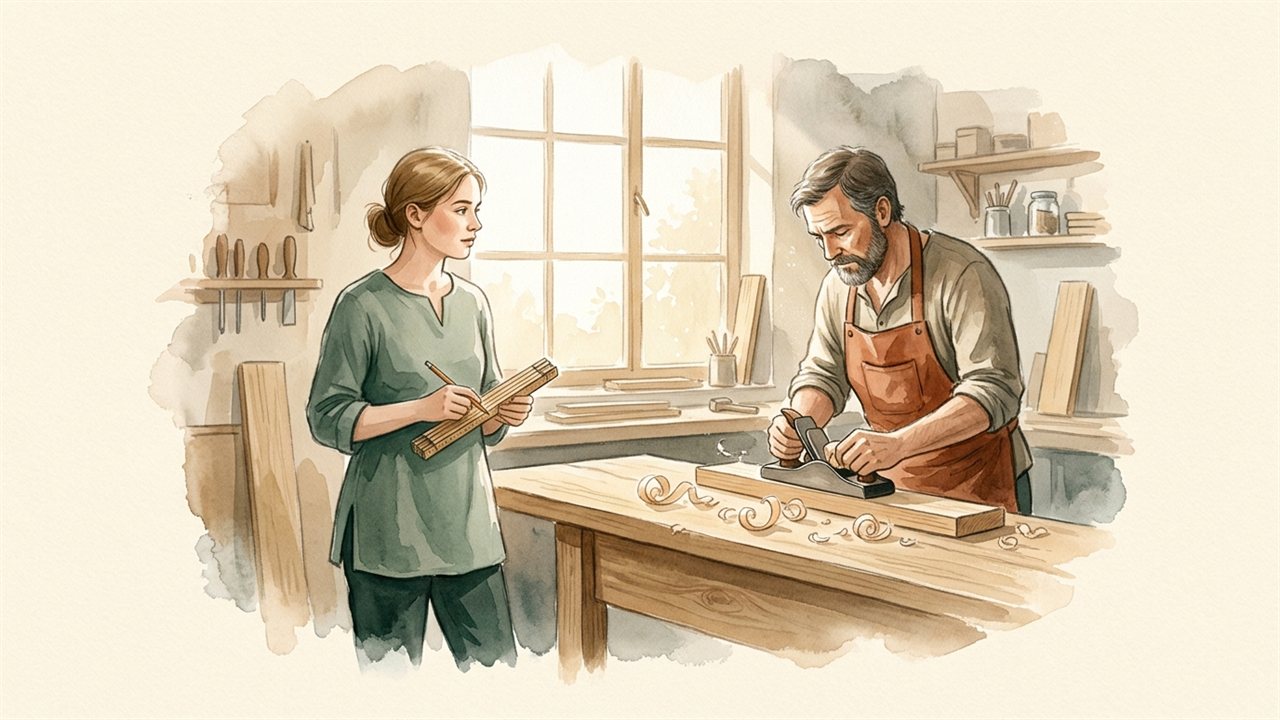
Step into a woodshop. A cabinetmaker is cutting a delicate dovetail joint by hand. Every cut requires exact pressure, steady breath, and unbroken concentration.
Now imagine an apprentice who wants to be perfectly thorough. Every ninety seconds, the apprentice taps the cabinetmaker on the shoulder. "Where is the medium sandpaper?" Two minutes later: "Should I wipe this board with a dry rag or a damp cloth?" Three minutes later: "Which drawer holds the brass hinges?"
The apprentice does not mean any harm. They are trying hard not to make a blunder. Yet by noon, the joint is ruined, the craftsperson has a raging headache, and the workshop has ground to a standstill.
Good mentors teach newcomers an essential working habit. Look around the bench first. Check the project notebook. Group small questions together, and wait for a natural stopping point before speaking.
The cost of a broken stride
When software engineers build AI assistants, they face a delicate puzzle. If an assistant guesses blindly whenever instructions are incomplete, it makes costly errors. It overwrites files, emails the wrong contact, or invents facts.
Because guessing is dangerous, many teams teach assistants to pause and ask for clarification. On paper, pausing sounds like the responsible choice. In daily practice, uncoordinated questions create a new problem.
Workplace studies show that human attention is remarkably fragile. When a notification interrupts a deep train of thought, recovering focus takes an average of over twenty-three minutes.1
Even worse, people who face frequent interruptions feel hurried and stressed. To keep up, they work faster, skip checks, and suffer mental fatigue.1
When an assistant interrupts you six times an hour, you do not provide thoughtful answers. You look for the fastest way to dismiss the dialogue box. Careful human judgment degrades into thoughtless clicking.
What this means
An assistant that interrupts constantly does not create safe collaboration. It creates clarification fatigue, pushing human partners to rubber-stamp decisions just to silence the screen.
How questions turn into bottlenecks
This challenge grows rapidly when multiple assistants collaborate on a shared project. Imagine three assistants helping you organize a community conference.
One assistant reviews caterers, another updates the schedule, and a third drafts room signage. If each assistant acts independently, inquiries arrive without rhythm or order.
The first assistant asks whether you prefer gluten-free boxed lunches. Two minutes later, the second asks whether a keynote speaker needs twenty minutes or thirty. A moment later, the third asks which font to use on directional banners.
Recent research terms this problem the attention bottleneck.2 Parallel agents can generate hundreds of plausible questions. But human attention is strictly serial and finite.
When parallel tools compete for supervisory attention without coordination, the system collapses. Important decisions wait in long queues, or frustrated users abandon the tools entirely.3
Three habits of a calm assistant
How do we protect human focus while keeping software safely bounded? Well-governed assistants adopt three habits that mirror a thoughtful apprentice.
1. Search local context before tapping the shoulder. A capable assistant checks existing files, commit history, and past project notes before asking a human partner. If a question was already settled in an earlier meeting, asking again is sheer laziness. Searching verified local records answers the majority of small doubts without disturbing anyone.2
2. Batch non-urgent questions at natural waypoints. Not every question carries the same urgency. An apprentice does not interrupt a mentor mid-cut to ask about tomorrow's lumber delivery. A calm assistant continues working on unblocked subtasks, holds secondary questions in a clean scratchpad, and presents them together when you finish your current task.
3. Distinguish irreversible acts from routine choices. An assistant should only interrupt immediately when an irreversible boundary is crossed. Deleting a database, spending budget, or publishing sensitive documents warrants an immediate pause. Choosing between two slide layouts does not.
Keeping technology in the periphery
Thirty years ago, computer scientist Mark Weiser described a concept he called calm technology.4 The most helpful tools do not shout for center stage. They sit in our sensory periphery, conveying reassurance with a glance and stepping forward only when genuine action is needed.
Today's conversational interfaces often do the opposite. They pop up modal windows, steal cursor focus, and ring chime alerts. They demand immediate answers for questions the software could have answered by reading the previous paragraph.
Protecting human judgment requires designing assistants that protect people's concentration. An assistant that works alongside you should feel like an experienced colleague in the same room. They do not whistle in your ear. They work steadily, keep tidy notes, and ask for guidance when it truly counts.
You can explore how teams coordinate clarification policies across parallel roles in our Shared Horizon atlas. Real safety comes from knowing which questions need a human answer and asking them with care.
Notes and sources
- Gloria Mark, Daniela Gudith, and Ulrich Klocke, "The Cost of Interrupted Work: More Speed and Stress," Proceedings of the SIGCHI Conference on Human Factors in Computing Systems (CHI 2008): 107–110, doi:10.1145/1357054.1357072; Gloria Mark, Victor M. Gonzalez, and Justin Harris, "No Task Left Behind? Examining the Nature of Fragmented Work," CHI 2005: 321–330, doi:10.1145/1054972.1055017.
- Hanzhao Wang, Shengjie Liu and Zhengchao Wang, "When Should AI Agents Ask? Clarification Requests Under Limited Human Attention" (2026), arXiv:2610.41129.
- Canwen Wang, Qing Xiao, Haiyi Zhu, and Hong Shen, "When AI Agents Act on Our Behalf: A Taxonomy of Human-Agent Interaction Failure" (2026), arXiv:2611.00291.
- Mark Weiser and John Seely Brown, "The Coming Age of Calm Technology" (1996), doi:10.1007/978-1-4612-0685-9_6; see also empirical peripheral agent notification architectures in arXiv:2606.09836 and arXiv:2602.19809.