
About · Founder
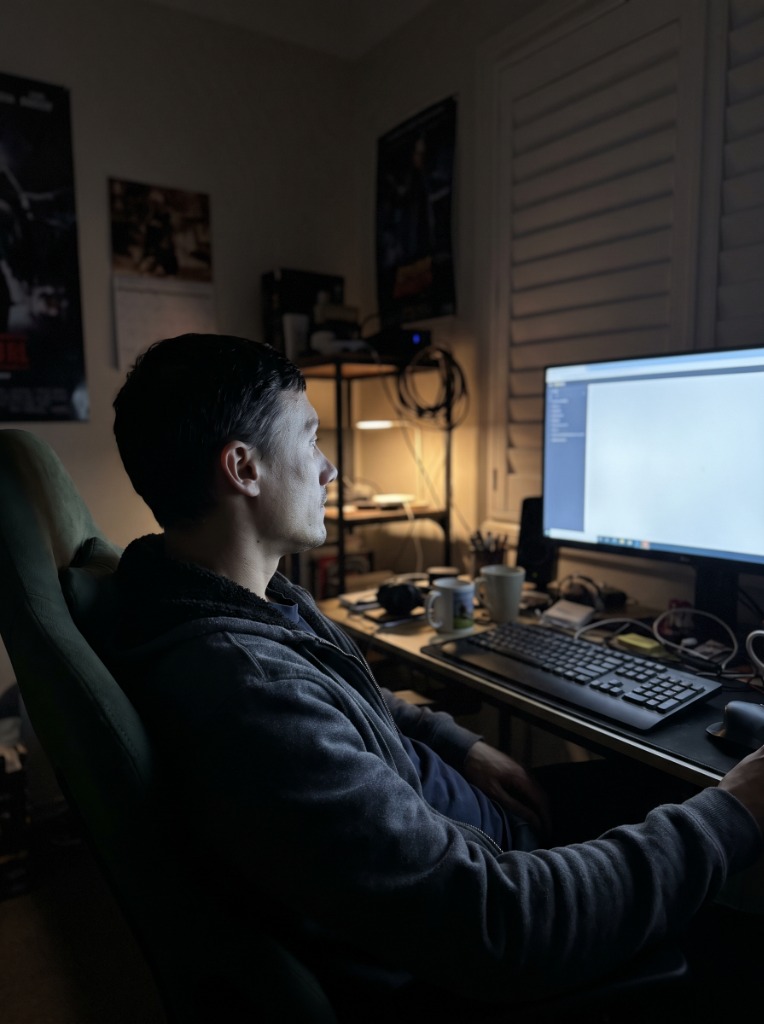
A project from a late-night desk, not a boardroom.
I'm a husband, a father, a twenty-year public servant in cybersecurity, and someone who has been taking machines apart since I was eight years old.
Age eight, and a wiring diagram
When I was eight, I took apart a Soviet clone of an early x186 personal computer and spent days tracing its paper wiring diagrams by hand. I wanted to see if I could coax colour out of a machine that only showed green monochrome text. Halfway through the schematic, I realised the four-bit colour capability was already sitting on the board, just never connected to an output pin.
Together with my dad and a local electrician, we soldered a custom video interface and hooked it up to our living-room television. Watching Test Drive and Grand Prix Circuit light up in colour taught me a lesson that never wore off. Software is never magic; real copper and silicon sit underneath every system, and you can always open the box to see who holds the switch.
Years later, when people talk about AI as if it were an inscrutable oracle floating in the clouds, I still think of that circuit board on our kitchen table. Every system has wires, permissions, and switches. The only question is whether the person using the machine is allowed to see the schematic.
Twenty years of watching institutions under stress
As an adult, I spent two decades in public service across cybersecurity and institutional defence. When you spend twenty years helping large organisations protect their networks and recover from failures, two patterns stay with you.
The first is how easily decent, dedicated people inside tall hierarchies lose touch with what is actually happening on the ground. Think of a game of telephone played up a ten-storey staircase. By the time a frontline technician's warning climbs five layers of management, every uncomfortable detail has been sanded off to fit what the next floor up wants to hear.
The second is the heavy price we all pay when institutions treat every piece of operational knowledge like a private fortress. When ten hospitals or ten municipalities each hoard their lessons behind closed doors, the same preventable failure can hit all ten of them in a row. Ordinary families and small teams end up paying for that friction.
What keeps a grid or a hospital safe is clear compartments, honest gauges that nobody is punished for reading aloud, and two-key locks on any switch that can hurt the public.
What living cells taught me about software
Outside of work, one of my favourite late-night habits is reading developmental biology and neuroscience papers for fun. Living organisms solved coordination problems hundreds of millions of years ago that computer engineering is only beginning to face.
Consider how thousands of cells in a salamander limb or a healing wound coordinate to rebuild complex tissue without a single "boss cell" barking orders from a central podium.1 Each cell reads local signals from its neighbours, checks its own boundaries, and contributes to the shared shape.
Or consider how every living cell depends on a selective membrane, like skin or a cell wall, that lets nourishment and honest signals pass while keeping its inner workings intact.2 A cell without a membrane dissolves into the soup around it; a cell sealed inside a brick wall starves. Life happens in the careful boundary between the two.
Those two biological habits shaped the whole architecture on this site. Your personal assistant should act like a healthy cell membrane around your records. It lets you engage on your own terms, without ad platforms or outside bots invading your attention. And our shared networks should coordinate like living tissue, without ever handing a master key to a single ruler.
A father's test for the next twenty years
When you are a parent, "the long term" stops being an abstract line on a chart. It has a name, a laugh, and a pair of shoes by the front door.
I ask myself what kind of world I want my family and neighbours to inhabit ten or twenty years from now, when software agents are ten times more capable than they are tonight. I want them to have tools that clear away bureaucracy and medical billing traps so they have more unhurried hours for craft, music, friendship, and rest.
I do not want them begging an opaque algorithm to appeal a civic decision. Nor should their digital assistant be secretly paid by the other side of the table.
Why build in the open from a home desk?
I love building with AI. Almost every night after the house goes quiet, agents running on my workstation help me read preprints, test simulations, audit primary sources, and draft the pages you are reading now. Yet I am also candid about why human stewardship has to sit at the centre of that loop.
Human minds take in the world at the pace of a walk or a kitchen-table conversation. We were not built to out-argue or out-click automated software swarms running millions of times faster than we think. If we plug those machines straight into today's bureaucracies or ad-driven platforms without new guardrails, we will lock in their worst habits at machine speed.
The answer isn't to stop building. Instead, we can build everyday civic safeguards that keep people in charge. These include clear action receipts, assistants bound loyally to one person, expiring capability leases, and a separate road for machine traffic.
Offered in good faith
This foundation doesn't come from a venture-capital boardroom, and it isn't selling a token, a subscription, or a miracle cure. Everything on this site is an open working notebook, and some of it will turn out to be wrong. I would much rather hear where an argument breaks from researchers, public officials, and neighbours early than find out when it is too late to mend.
If you want to test an idea, challenge an assumption, or build alongside us, please explore our research, labs, and essays, or write to us directly.
Sources
- Michael Levin, "Technological Approach to Mind Everywhere: An Experimentally-Grounded Framework for Understanding Diverse Bodies and Minds," Frontiers in Systems Neuroscience 16 (2022). ↩
- Karl Friston, "Life as We Know It," Journal of the Royal Society Interface 10, no. 86 (2013). ↩