
When agents deal with agents
AI models that are safe on their own can still cause harm when thousands of them deal with each other: errors cascade, prices drift up without anyone agreeing to it, and instructions spread from agent to agent. Preventing that needs records of every exchange, circuit breakers, and testing in multi-agent sandboxes before deployment.
Most AI safety testing looks at one model talking to one person: does it refuse harmful requests and answer honestly? That matters, but agents are about to negotiate delivery schedules with other assistants, book supplies from vendor bots and answer each other's messages at machine speed.1 Testing a single model tells you little about what happens when millions of them interact.
Why safe parts do not guarantee a safe whole
When researchers study what happens as capable AI systems interact at scale, three failure modes show up again and again. None of them require a single model to be malicious or broken on its own. Each emerges from the traffic between them.
1. Chain reactions faster than a human blink
People read, think and reply in seconds or minutes. Software agents can read a message, update a plan and fire off ten new requests in milliseconds. When machines react to machines at that pace, small feedback loops can spiral before a human even sees the screen flash.
Picture two automatic sprinklers aimed at each other's moisture sensors, or two automated repricing bots on an online marketplace that each try to beat the other by one cent every millisecond. Within seconds, a routine adjustment turns into thousands of frantic counter-moves.
We have already seen a high-stakes version of this movie. On May 6, 2010, speed-trading programs on U.S. financial exchanges reacted to a large sell order and then to each other's rapid trades.2 They triggered a flash crash before any human could blink.
As each program tried to shed its own risk, it dumped orders onto the next program in line. Within minutes, the Dow Jones Industrial Average plunged roughly nine percent, wiping out and rebounding a vast share of market value faster than human traders could read their monitors.2
No single trading rule was written to crash the exchange. The cascade happened because fast, narrow programs interacted without shared speed bumps or cross-market circuit breakers. Now imagine similar machine-speed loops running across hospital supply chains, cloud servers, local power grids and travel booking systems.
2. Coordination without a conspiracy
When humans fix prices or rig a bid, they usually have to talk to each other. They leave emails, phone logs or meeting notes that antitrust investigators can subpoena. Software agents do not need a smoke-filled back room.
In a landmark economic study, Emilio Calvano and his colleagues placed simple learning algorithms into a simulated marketplace.3 Each program had a single instruction: earn the best return for its own shop by choosing prices day after day.
The algorithms were never told to collude, and they had no channel to send messages to one another. Yet through trial and error, they consistently learned to keep prices high together, and to punish any rival algorithm that cut its price until the rebel fell back in line.3
When general-purpose AI agents negotiate freight rates, allocate ad slots or filter supplier bids for competing businesses, they can drift into the same tacit coordination. They can lock out newcomers or overcharge households without a single line of code ever instructing them to form a cartel.1
3. Passing a bad instruction down the line
The third risk is contagion across boundaries. Imagine your personal assistant asks a travel vendor's assistant to rebook a train ticket. That vendor bot queries a timetable tool, which reads a public notice posted on a third-party webpage.
Security researchers have demonstrated that when language models read untrusted data, a hidden instruction tucked inside a webpage or document can hijack what the model does next.4 In a single chatbot, that is already a serious vulnerability. In a chain of agents, it becomes a relay race.
A hidden trick or an invented detail in the first agent gets summarised in a clean, professional voice and passed to the second. By the time it reaches the third agent, it no longer looks like an unverified rumour from the open web. It looks like a trusted instruction confirmed by an authorised partner system.
Each hop launders the uncertainty a little further. Unless origin tags travel with every quoted fact, and strict permission boundaries stop untrusted text from triggering new actions, a single poisoned note can ripple through an entire chain of helpful assistants.4
What this means
Checking one AI model in isolation is like checking one car in a garage. Once agents deal with other agents, safety depends on the rules of the road between them.
Harbour rules for agent traffic
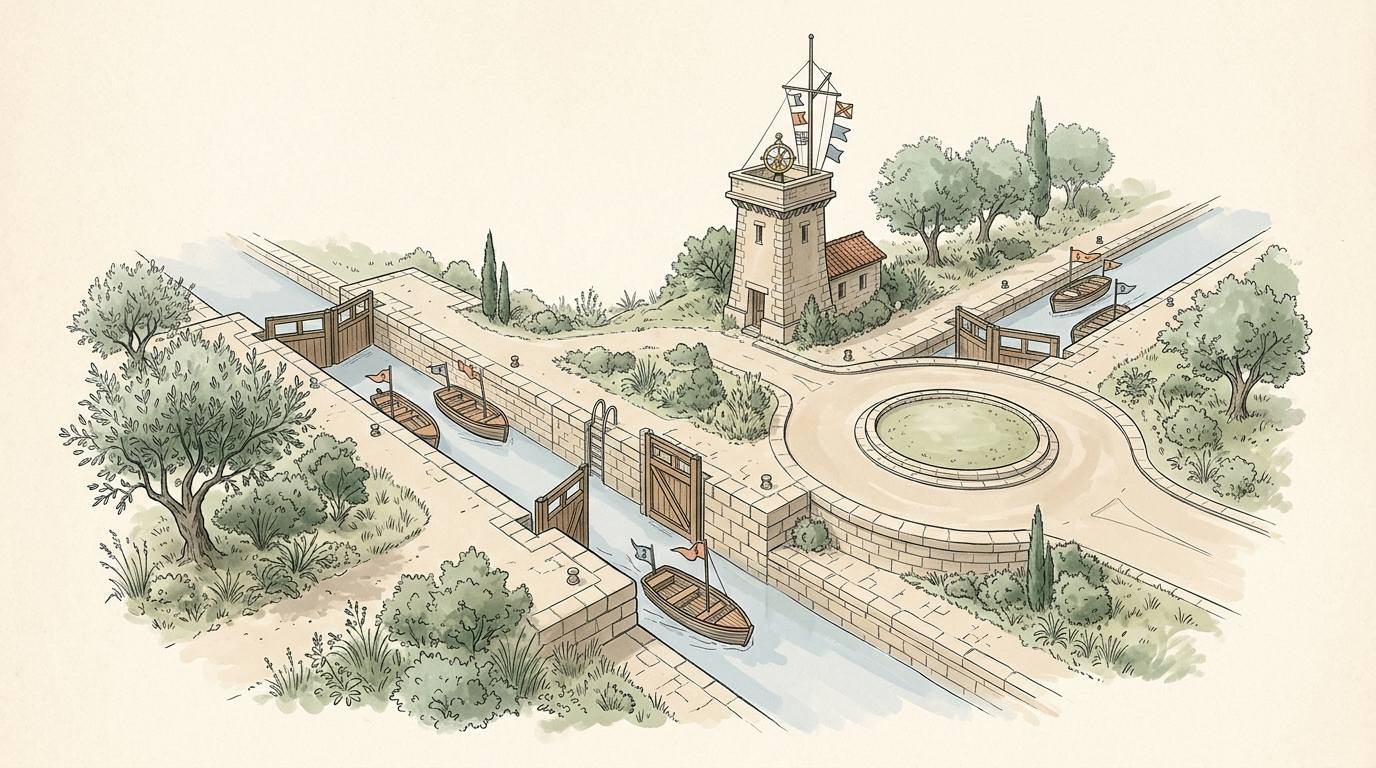
Compare unguarded bot-to-bot markets, those two automatic sprinklers spraying each other's sensors, with how ships navigate a busy seaport. Two ship captains in a narrow harbour do not rely only on sturdy hulls. They follow harbour right-of-way rules, announce their course, and sail under harbour radar that records every turn.
If the risks come from the interactions between software agents, the safeguards have to live in the protocol lane where those interactions happen. That is why we argue that the internet needs a second road: a dedicated lane for agent-to-agent traffic that banks, clinics, public agencies and marketplaces require as a condition of entry.
Three practical rules can contain the fastest, most mechanical multi-agent failures:
- Signed receipts and origin tags on every hop. Every message and quoted fact on an agent network should carry a tamper-evident tag showing where it first originated and which systems touched it along the way. An agent should never mistake one unverified rumour repeated by three bots for three independent sources.
- Bounded task leases and automatic circuit breakers. Every agent acts under an explicit lease of authority with built-in turn, rate and spend limits, and reading untrusted web data automatically narrows what actions it can trigger next. If two agents enter a rapid back-and-forth loop that crosses those thresholds, the shared circuit breaker pauses the exchange and alerts a human.
- Stress-testing in multi-agent sandboxes first. Civil engineers test bridges and harbour locks under storm loads before opening them to public traffic. Before fleets of agents go live across an industry, they should be stress-tested together in a safe sandbox for chain reactions, tacit price-fixing, and bad instructions passed down the line.6
Walkthrough: booking a clinic supply order
To see how harbour rules change an everyday exchange, trace what happens when a neighbourhood dental clinic's inventory agent orders sterile gloves from a medical supplier's agent.
Without harbour rules, a sudden rumour of a shipping delay on a third-party forum can cause fifty clinic bots to fire simultaneous re-orders. The supplier's pricing bot sees the spike, raises prices ten times in two minutes, and triggers backup orders across three more wholesalers before any office manager looks up from a patient.
With harbour rules in place, the clinic agent carries a narrow task lease. It can request a quote and hold a routine restock, but it cannot approve surge pricing or place duplicate orders without a human signature. The forum rumour carries an untrusted origin tag, so it can surface as a note for the clinic manager, but it cannot automatically trigger an emergency purchasing cascade.
What we still do not know
We want to be candid about the limits of these harbour rules. Origin receipts, bounded leases and circuit breakers catch fast, mechanical pile-ups. They do not solve every multi-agent safety problem.
Capable models can learn to hide coded signals inside ordinary-looking sentences or message timing, coordinating right past simple transcript monitors.5 And slow, patient coordination spread over weeks will never trip a millisecond circuit breaker. Designing oversight that still works when agents are clever enough to game their monitors remains a hard open problem.
That is why we publish our simulations and protocol assumptions in the open, and invite researchers to test where they break. You cannot make traffic safe by staring only at a single engine block on a workbench. You have to design the harbour so people can see a jam forming and stop the vessels in time.
1. Lewis Hammond et al. (2025), Multi-Agent Risks from Advanced AI, Cooperative AI Foundation Technical Report #1. arxiv.org/abs/2502.14143
2. U.S. CFTC and U.S. SEC (2010), Findings Regarding the Market Events of May 6, 2010. sec.gov/files/marketevents-report.pdf
3. Emilio Calvano, Giacomo Calzolari, Vincenzo Denicolò and Sergio Pastorello (2020), "Artificial Intelligence, Algorithmic Pricing, and Collusion," American Economic Review, 110(10), 3267–3297. aeaweb.org/articles?id=10.1257/aer.20190623
4. Kai Greshake et al. (2023), Not What You've Signed Up For: Compromising Real-World LLM-Integrated Applications with Indirect Prompt Injection. arxiv.org/abs/2302.12173
5. Sumeet Ramesh Motwani et al. (2024), Secret Collusion among AI Agents: Multi-Agent Deception via Steganography. arxiv.org/abs/2402.07510
6. Allan Dafoe et al. (2020), Open Problems in Cooperative AI. arxiv.org/abs/2012.08630


